
CARB Phase 2 Bamboo Furniture Boards: Controlling Formaldehyde Off-Gassing
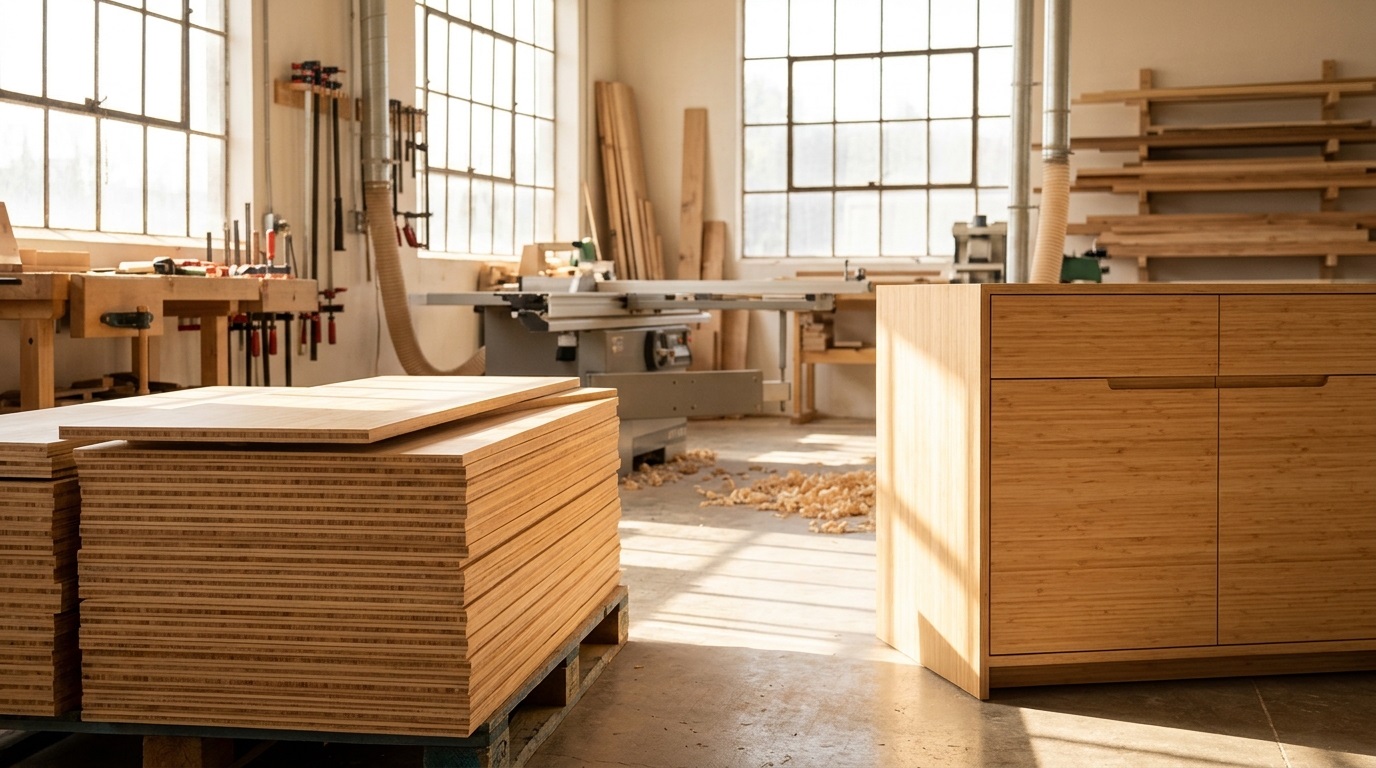
CARB Phase 2 compliant bamboo furniture boards must emit no more than 0.05 parts per million (ppm) of formaldehyde when evaluated under ASTM E1333 large-chamber testing. This threshold aligns directly with federal EPA TSCA Title VI regulations and represents the baseline requirement for engineered bamboo panels entering North American residential, hospitality, and commercial furniture supply chains.
Raw bamboo culms contain almost no free formaldehyde. Off-gassing in finished cabinetry, shelving, and tabletops comes from the synthetic adhesives used to bond bamboo strips or crushed fibers together under heat and pressure. Furniture manufacturers and importers who understand resin chemistry, press curing parameters, and third-party certification protocols can eliminate regulatory hold-ups at port while delivering low-VOC furniture that meets strict indoor air quality specifications.
Why Formaldehyde Off-Gassing Occurs in Engineered Bamboo
Measurable formaldehyde emissions in bamboo furniture boards originate from unreacted free formaldehyde trapped inside cured adhesive glue lines and from slow chemical breakdown of unstable resin bonds over time. Natural Moso bamboo (Phyllostachys edulis) holds only trace biogenic formaldehyde between 0.005 and 0.015 ppm, meaning the adhesive formulation and hot-press cycle govern nearly all off-gassing behavior.
Resin Chemistry and Hydrolysis
Traditional urea-formaldehyde (UF) resins remain inexpensive and cure rapidly, yet their chemical cross-links are vulnerable to moisture. When ambient humidity rises above 55 percent or indoor temperatures climb, water vapor reacts with weakly bonded methylol groups inside standard UF glue lines. This reaction, known as hydrolysis, releases formaldehyde gas steadily into surrounding room air for months or even years after assembly.
High-grade bamboo board mills prevent chronic hydrolysis by replacing standard UF binders with melamine-fortified urea-formaldehyde (MUF), phenol-formaldehyde (PF), or no-added-formaldehyde (NAF) adhesives such as polymeric diphenylmethane diisocyanate (pMDI) and modified soy proteins. These denser polymer networks resist moisture attack and lock residual volatiles inside the cured bond line.
Grain Structure and Glue Volume
Board construction directly determines how much adhesive enters a finished panel. Horizontal and vertical laminated bamboo boards arrange precision-milled rectangular strips side by side in single or multi-ply layers. Because strips fit tightly with minimal voids, glue spread rates stay relatively low at 180 to 240 grams per square meter, keeping total resin content near 2 to 3 percent of dry panel weight.
Strand-woven bamboo boards follow a different mechanical process. Mills crush bamboo culms into fibrous bundles, coat them in phenolic resin, and compress them under extreme hydraulic pressure exceeding 2,000 tons. Because every fiber bundle requires full wetting, strand-woven blocks carry 10 to 14 percent resin solids by weight. Higher resin volume demands stricter press-temperature control and longer post-press curing so excess volatiles vent before panels ship.
CARB Phase 2 and Global Emission Standards Compared
CARB ATCM 93120 Phase 2 sets a maximum emission ceiling of 0.05 ppm for veneer-core and composite-core plywood panels, matching federal EPA TSCA Title VI limits across all 50 US states and cutting allowable emissions to half the standard European E1 threshold. Buyers sourcing bamboo panels internationally must compare test methods alongside numerical limits, as chamber temperature, air exchange rates, and loading ratios vary across jurisdictions.
| Standard / Grade | Applicable Board Type | Max Emission Limit | Primary Test Method | Target Market Scope |
|---|---|---|---|---|
| CARB Phase 2 | Hardwood Plywood / Composite Core | 0.05 ppm | ASTM E1333 / D6007 | California, USA |
| EPA TSCA Title VI | Hardwood Plywood / Composite Core | 0.05 ppm | ASTM E1333 / D6007 | All US States |
| CARB / EPA NAF | No-Added-Formaldehyde Panels | 0.04 ppm (90% of tests) | ASTM E1333 / D6007 | North America |
| GB/T 39600 E1 | Interior Wood & Bamboo Panels | 0.124 mg/m³ (~0.10 ppm) | GB/T 17657 (1m³ Chamber) | China / Asia |
| GB/T 39600 E0 | Low-Emission Furniture Boards | 0.050 mg/m³ (~0.04 ppm) | GB/T 17657 (1m³ Chamber) | China / Global Export |
| GB/T 39600 ENF | Aldehyde-Free Grade Boards | 0.025 mg/m³ (~0.02 ppm) | GB/T 17657 (1m³ Chamber) | Premium Interior Spec |
| EN 717-1 E1 | Wood-Based Furniture Panels | 0.10 ppm (0.124 mg/m³) | EN 717-1 Chamber | European Union |
While CARB Phase 2 and EPA TSCA Title VI regulate hardwood plywood at 0.05 ppm, particleboard at 0.09 ppm, standard medium-density fiberboard (MDF) at 0.11 ppm, and thin MDF under 8 millimeters at 0.13 ppm, architectural bamboo boards sold for casegoods almost universally benchmark against the strictest 0.05 ppm plywood tier.
Regulatory Scope for Solid Bamboo
A common compliance gap catches importers off guard during customs clearance. Under strict statutory definitions, 100 percent solid laminated bamboo consists of grass strips rather than wood veneers, placing pure bamboo panels outside the literal text of hardwood plywood rules. However, two commercial realities make CARB Phase 2 and TSCA Title VI certification mandatory in practice.
First, any composite panel that laminates a hardwood face or back veneer—such as oak, walnut, ash, or birch—onto a bamboo core falls squarely under the legal definition of composite-core hardwood plywood (HWPW-CC) and must meet the 0.05 ppm ceiling by law. Second, major North American furniture retailers, hospitality procurement groups, and commercial millwork buyers enforce uniform TSCA Title VI compliance across all engineered bamboo SKUs to eliminate legal ambiguity and protect indoor air quality warranties.
Resin Systems Used in Low-Emission Bamboo Boards
Selecting the right adhesive system allows bamboo board mills to achieve consistent sub-0.05 ppm chamber results without sacrificing shear strength or screw-holding capacity. Standard urea-formaldehyde glues cannot reliably pass CARB Phase 2 verification unless heavily modified, pushing quality-focused mills toward four primary resin categories.
| Resin System | Typical Emission Range | Moisture Resistance | Press Temp (°C) | Primary Furniture Application |
|---|---|---|---|---|
| Standard UF | 0.08 – 0.15 ppm | Low (Dry indoor only) | 110 – 125°C | Non-regulated budget backing |
| Low-Mole MUF | 0.03 – 0.05 ppm | Moderate to High | 125 – 140°C | Cabinetry, shelving, tabletops |
| Phenol-Formaldehyde (PF) | 0.01 – 0.03 ppm | High (Boil-proof) | 135 – 155°C | Strand-woven frames, humid zones |
| pMDI / Soy NAF | 0.005 – 0.02 ppm | High | 115 – 135°C | Nursery furniture, healthcare millwork |
Low-mole-ratio melamine-urea-formaldehyde (MUF) resins represent the workhorse binder for interior architectural bamboo plywood. Adding 12 to 18 percent melamine reinforces the polymer backbone against moisture while preserving a clean, light-colored glue line that blends seamlessly into natural blonde or caramelized bamboo strips.
Hot-Press Curing and Off-Gassing Buffers
Even the cleanest resin formula fails chamber testing if press parameters drift out of tolerance. Bamboo strips must enter the glue spreader at a uniform moisture content between 6 and 10 percent. Excess moisture inside the strips dilutes resin solids, retards cross-linking, and leaves uncured formaldehyde pockets trapped inside the board core.
After hot pressing, disciplined mills stack freshly pressed bamboo panels on ventilated spacers inside a dry conditioning warehouse for 7 to 14 days prior to final sanding and shrink-wrapping. During this off-gassing buffer window, surface-bound volatiles dissipate naturally into circulating air, dropping subsequent ASTM D6007 small-chamber readings by 30 to 45 percent compared to boards wrapped straight off the press line.
Step-by-Step Verification When Sourcing CARB Phase 2 Boards
Reliable procurement requires verifying physical chain-of-custody records rather than relying on verbal supplier assurances or generic PDF brochures. Importers should audit third-party lab credentials, confirm mill-level lot stamps, and test pre-shipment board samples before releasing final container balances.
Auditing Third-Party Certifiers
CARB and the EPA authorize independent Third-Party Certifiers (TPCs)—including organizations such as SGS, Intertek, UL, TÜV Rheinland, and PFS TECO—to audit panel factories quarterly and validate in-house quality control labs. When reviewing a supplier certificate, verify that the factory name and physical street address on the TPC document match the actual manufacturing facility rather than an intermediary trading office.
Confirm that the certificate covers the exact board thickness range and resin system specified in your purchase order. A mill certified solely for 18-millimeter MUF bamboo panels cannot apply that same TPC number to 12-millimeter boards bonded with a different adhesive batch.
Verifying Panel Stamps and Lots
Under CARB 93120 and TSCA Title VI labeling rules, every individual panel or strapped bundle shipped into North America must display a permanent, legible stamp. That stamp must list four data points: the panel producer name, a unique production lot or batch number, the assigned TPC identification number, and explicit compliance wording stating both CARB Phase 2 and TSCA Title VI conformity.
| Verification Item | Required Spec or Document | Red Flag to Reject | Inspection Stage |
|---|---|---|---|
| TPC Certificate | Active CARB/EPA TPC ID matching mill address | Trading firm listed instead of factory | Supplier Onboarding |
| Chamber Lab Report | ASTM E1333 or D6007 result at or below 0.05 ppm | Report older than 6 months or wrong thickness | Pre-Order Review |
| Board Edge Stamp | Producer ID, Lot #, TPC #, Phase 2 / TSCA text | Missing lot number or smeared ink | Pre-Shipment Audit |
| Core Moisture Content | 6% – 10% across core and face plies | Above 12% (triggers resin hydrolysis) | In-Line QC Check |
| Random Sample Test | Foil-wrapped board cut sent to accredited lab | Factory refuses unannounced sample pull | Before Container Seal |
For high-volume furniture contracts, pull one random panel from the middle of a production stack, seal it immediately in aluminum foil and polyethylene film to preserve volatile levels, and courier the specimen to an accredited lab for a 24-hour ASTM D6007 small-chamber check before loading the shipping container.
Minimizing Off-Gassing During Furniture Fabrication
Board compliance at the mill solves only part of the indoor emissions equation. Furniture workshops can inadvertently raise VOC release during CNC machining, edge preparation, and surface finishing if raw bamboo cores remain exposed or if incompatible solvent coatings trap uncured gases inside assembled cabinets.
Edge Sealing and Surface Coatings
Rough-sawn bamboo edges expose open vascular bundles and cross-cut glue lines where off-gassing occurs fastest. Sealing all exposed perimeter edges with 0.5-millimeter to 2.0-millimeter solid bamboo or zero-VOC ABS edge banding using moisture-cured polyurethane (PUR) hot-melt adhesive creates an effective physical barrier.
On broad tabletop and cabinet door faces, waterborne polyurethane and UV-cured acrylic lacquers outperform traditional acid-catalyzed conversion varnishes. Conversion varnishes rely on formaldehyde-releasing melamine or urea cross-linkers that add secondary emissions to an otherwise compliant CARB Phase 2 substrate, whereas UV-cured acrylics polymerize instantly under ultraviolet lamps with near-zero residual off-gassing.
Storage and Transit Humidity Control
Finished bamboo furniture parts stored in unconditioned factories or sealed inside damp ocean containers face renewed hydrolysis risk. Keep workshop storage below 25 degrees Celsius and 55 percent relative humidity, and allow freshly machined or coated components to air out for at least 72 hours before sealing them inside retail cartons. Placing desiccant packs inside export containers protects both dimensional stability and low-emission performance from port departure through final retail installation.