
Bamboo Cabinetry Screw Holding Capacity: Will Hinges Pull Out?
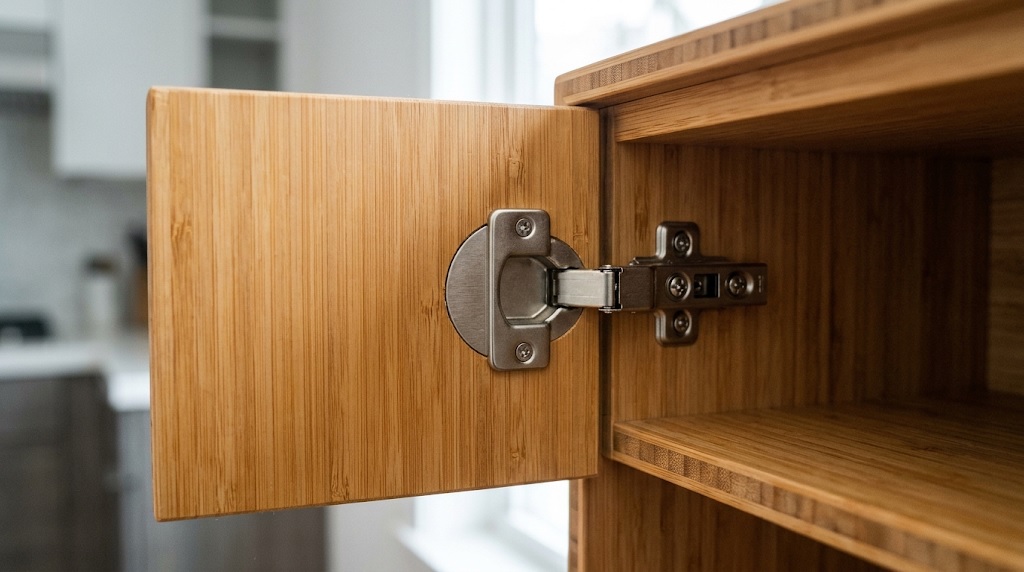
Quality bamboo cabinetry holds cabinet hinges securely, and hinges will not pull out on their own during normal daily use. When built from architectural-grade 3/4-inch (19mm) cross-laminated bamboo panels, the material matches or exceeds domestic birch and maple cabinet plywood in screw withdrawal resistance and outperforms industrial particleboard and MDF by a wide margin.
Most homeowners and kitchen designers ask this question after hearing stories about hinges tearing out of older particleboard boxes or worrying that bamboo is a grass rather than a true hardwood. Those concerns are fair, especially when heavy pantry doors swing open dozens of times a day. In practice, hinge pull-out in bamboo cabinets almost never stems from weak raw material. Failures trace back to poor panel construction, skipped pilot holes, wrong screw geometry, or over-tightened power drivers that shred the fibers before the door ever sees its first week of service.
Why Bamboo Holds Fasteners Differently Than Wood
Botanically, Moso bamboo is a giant woody grass that reaches structural maturity in roughly four to six years. Unlike softwoods or hardwoods that grow outward in annual rings, a bamboo culm packs dense vascular bundles along its outer wall, running straight from base to tip. Manufacturers mill those culms into rectangular strips, kiln-dry them, and laminate them under heat and pressure into solid multi-ply sheets.
That linear fiber structure gives bamboo high tensile strength and a remarkably hard surface. Standard laminated Moso bamboo panels typically sit in the 650 to 750 kilograms per cubic meter density range, putting them slightly ahead of standard birch plywood and right alongside medium-to-heavy domestic hardwoods. When a screw thread cuts into laminated bamboo, those tough longitudinal fibers grip the flanks of the metal tightly and resist crushing under the hinge plate.
Compare that behavior with conventional cabinet box materials. Industrial particleboard relies on wood chips bound with resin; it holds a screw well enough on day one, yet repeated door slams and minor kitchen humidity gradually crumble the surrounding chips until the screw spins freely. Medium-density fiberboard offers a smooth face, but its fine dust-like core lacks long fibers to resist axial pull-out, particularly near panel edges. Multi-ply bamboo behaves much closer to hard maple plywood, with one important caveat: bamboo is stiffer and less compressible than softwood or poplar cores, so it punishes sloppy drilling habits.
How Bamboo Panel Construction Shapes Screw Grip
Not every sheet sold under a bamboo label performs the same way on a hinge jig. Under standard mechanical test methods such as ASTM D1037 and ASTM D1761, screw withdrawal resistance depends heavily on ply orientation, resin density, and whether the fastener enters the panel face or the exposed edge.
Multi-Ply Cross-Laminated Panels
Architectural cabinet panels are rarely a single solid layer of parallel bamboo strips. Reliable 3/4-inch cabinet stock uses three-ply or five-ply construction, alternating the grain direction of the inner core layers at ninety degrees to the outer faces. When a cabinet screw passes through the surface ply and bites into a perpendicular core layer, the cross-banded glue lines act like built-in reinforcement. Even if a door takes a hard sideways knock, the alternating grain stops a split from traveling down the hinge mortise.
Vertical vs. Horizontal Grain
Horizontal-grain bamboo displays the distinctive wide knuckles of the flattened culm, while vertical-grain bamboo turns narrow strips on edge to produce thin, uniform pinstripes. Both styles share similar overall density when laminated onto a cross-ply core, and both hold European concealed hinges reliably. Still, seasoned cabinetmakers often notice slightly more consistent screw bite in vertical-grain panels because the glue lines are spaced evenly every few millimeters across the entire hinge mounting zone, reducing the chance of hitting a softer pith transition near a node.
Strand-Woven Bamboo Density
Strand-woven bamboo takes shredded bamboo fibers, saturates them with adhesive, and compresses them under extreme pressure. The finished board regularly exceeds 1,000 kilograms per cubic meter, making it denser than red oak or hard maple. Screw holding capacity in strand-woven stock is extraordinary, yet installers have to respect its hardness. Driving a standard wood screw into strand-woven bamboo without an accurately sized pilot hole will often shear the head clean off the shank before the hinge seats flush.
Face Holding vs. Edge Holding
Cabinet hinges rely mainly on face holding: mounting plates screw straight into the flat interior side of the cabinet box, and 35mm concealed cup hinges bore into the flat back of the door. Bamboo excels in face-holding applications because screws cross multiple solid fibers and laminated plies. Edge holding—driving screws directly into the narrow 3/4-inch edge of a panel—is naturally lower in any sheet good, bamboo included. Good frameless cabinet shops avoid relying on edge-driven hinge screws and use dowels, confirmat fasteners, or biscuits for structural box joinery instead.
Why Hinges Actually Pull Out of Bamboo Cabinets
When a bamboo cabinet door starts sagging or a mounting plate pulls loose, the culprit is almost always an avoidable shop or jobsite mistake rather than a flaw in the plant fiber itself.
Skipping Pilot Holes
Because bamboo fibers are dense and packed closely together, forcing a tapered wood screw into an un-drilled surface acts like a miniature splitting wedge. The stress may not crack the panel visibly right away, especially near the thin wall beside a 35mm hinge cup bore, yet microscopic fractures weaken the grip around the threads. Six months of swinging a heavy door widens those tiny splits until the screws back out.
Over-Torquing With Impact Drivers
Modern cordless impact drivers are fantastic for framing lumber and completely wrong for cabinet hardware. One extra burst of hammering spins the screw threads inside the bamboo, shearing off the wood fibers that sit between each ridge of metal. Once those internal threads strip out, the hole looks tight from the outside while offering almost zero holding power.
Wrong Screw Length or Thread
Installing hinges with short 1/2-inch screws barely engages the outer veneer ply, leaving the sturdy cross-laminated core untouched. Coarse drywall screws are another common jobsite shortcut; their thin, brittle shanks snap under shear loads, and their bugle heads do not seat flat inside countersunk hinge slots.
Too Few Hinges on Tall Doors
Solid laminated bamboo weighs noticeably more per square foot than hollow-core doors, thermofoil MDF, or lightweight birch ply. Hanging a tall pantry door or an extra-wide wall cabinet door on just two hinges puts massive cantilever leverage on the top hinge plate. Over thousands of cycles, gravity works continuously against those two small screws at the top corner.
Steam and Moisture Exposure
Kitchens produce constant heat and vapor around dishwashers, kettles, and ranges. While cured bamboo panels handle normal indoor humidity well, raw unsealed hinge bores and mounting holes exposed directly to rising steam can swell slightly and soften over time. Repeated expansion and contraction gradually loosen tight metal fasteners.
Best Practices for Installing Hinges in Bamboo
Getting rock-solid, decades-long hinge retention out of bamboo cabinetry comes down to a handful of straightforward shop habits.
Match the Fastener to the Panel
- 5mm System Euro Screws: For frameless European cabinetry, 5mm Euro screws (usually 11mm to 13mm long for standard mounting plates) are the gold standard. They have thick shanks, blunt tips, and aggressive, deep threads engineered specifically for pre-drilled 5mm system holes in sheet goods.
- Nylon Press-In Dowels: Many high-end concealed cup hinges come with pre-mounted 8mm nylon expansion dowels alongside the 35mm cup. Drilling clean 8mm holes and pressing those dowels in spreads the clamping force evenly across the bamboo bore and lets you remove and reinstall doors repeatedly without wearing down the bamboo threads.
- Deep-Thread Cabinet Screws: When mounting plates or face-frame hinges require wood screws, use #8 deep-thread pan-head or truss-head cabinet screws sized at 5/8 inch for 3/4-inch panels. That length penetrates deeply into the core ply without poking through the finished outer face.
Drill Clean Pilot Holes
Bamboo naturally contains microscopic traces of silica, which dulls cheap high-speed steel drill bits faster than ordinary softwood. Use sharp carbide-tipped Forstner bits for 35mm hinge cups and crisp brad-point bits for mounting holes. Standard European cup bores sit between 11.5mm and 13mm deep in a 19mm door—always double-check your drill press stop collar so you preserve a solid backing layer behind the cup. For wood screws, size the pilot hole to match the screw’s root diameter so the threads slice cleanly into fresh bamboo without wedging the strips apart. Finish tightening with a drill clutch set low or turn the final quarter-turn with a hand screwdriver.
Size Hinge Count to Door Weight
Never guess at hinge count on bamboo doors. Standard upper or base doors under 36 inches tall generally run fine on two quality European hinges, provided the door stays under roughly 20 inches wide. Once a bamboo door climbs past 36 to 40 inches in height—or stretches wider than 24 inches—add a third hinge near the top third of the door where pull-out forces peak. Full-height 80-inch bamboo pantry doors routinely need four or five hinges spaced closer toward the upper half to keep the top plate from bearing all the leverage.
Specify Soft-Close Dampening
Slamming doors generate sudden shock loads that multiply static weight forces several times over. Built-in soft-close hydraulic dampers catch the momentum of a heavier bamboo door during the last few inches of travel, easing it shut quietly and protecting every hinge screw in the kitchen from impact fatigue.
Repairing a Stripped Hinge Hole in Bamboo
Even if an installer over-tightens a screw or someone leans hard on an open door, a stripped hinge hole in bamboo cabinetry is easy to fix permanently. Skip soft wood putty or quick-dry filler—neither material holds metal threads under tension.
For minor stripping on a mounting plate, drill the worn hole out cleanly to 1/4 inch or 5/16 inch, glue in a fluted hardwood or solid bamboo dowel with standard PVA wood glue, let it cure overnight, pare it flush with a sharp chisel, and re-drill a fresh pilot hole. If the area around a 35mm cup bore has chewed out, switching to 8mm press-in nylon repair dowels or installing a thin stainless steel hinge repair plate spans fresh, undamaged bamboo around the perimeter and restores full holding strength in minutes.
Frequently Asked Questions
Is bamboo stronger than plywood?
In surface hardness and face screw retention, architectural multi-ply bamboo generally matches or slightly outperforms domestic birch and maple cabinet plywood. Both materials rely on cross-banded plies for dimensional stability and far outlast particleboard or MDF in high-use kitchens.
Should you use Euro screws?
Yes, whenever your cabinet boxes are drilled on a 32mm system grid. Thick-bodied 5mm Euro screws offer deeper thread engagement and much higher pull-out resistance in laminated bamboo than narrow tapered wood screws.
Are bamboo doors heavier?
Yes, 3/4-inch laminated bamboo doors typically weigh slightly more than maple plywood doors of the same size and noticeably more than pine or hollow-core doors. Accounting for that extra mass by adding a third hinge on tall or wide doors prevents sagging and screw fatigue.
Does bamboo split when screwed?
Bamboo can split if dry wood screws are driven too close to an edge without pre-drilling. Drilling properly sized pilot holes with sharp bits and keeping fastener torque controlled eliminates splitting almost completely.